

From Noumea, a few hours are enough to spend the night off a sandy islet or at the head of a red-earth bay. These are the anchorages we use with myCloud, and what we look at before dropping the hook or picking up a mooring.
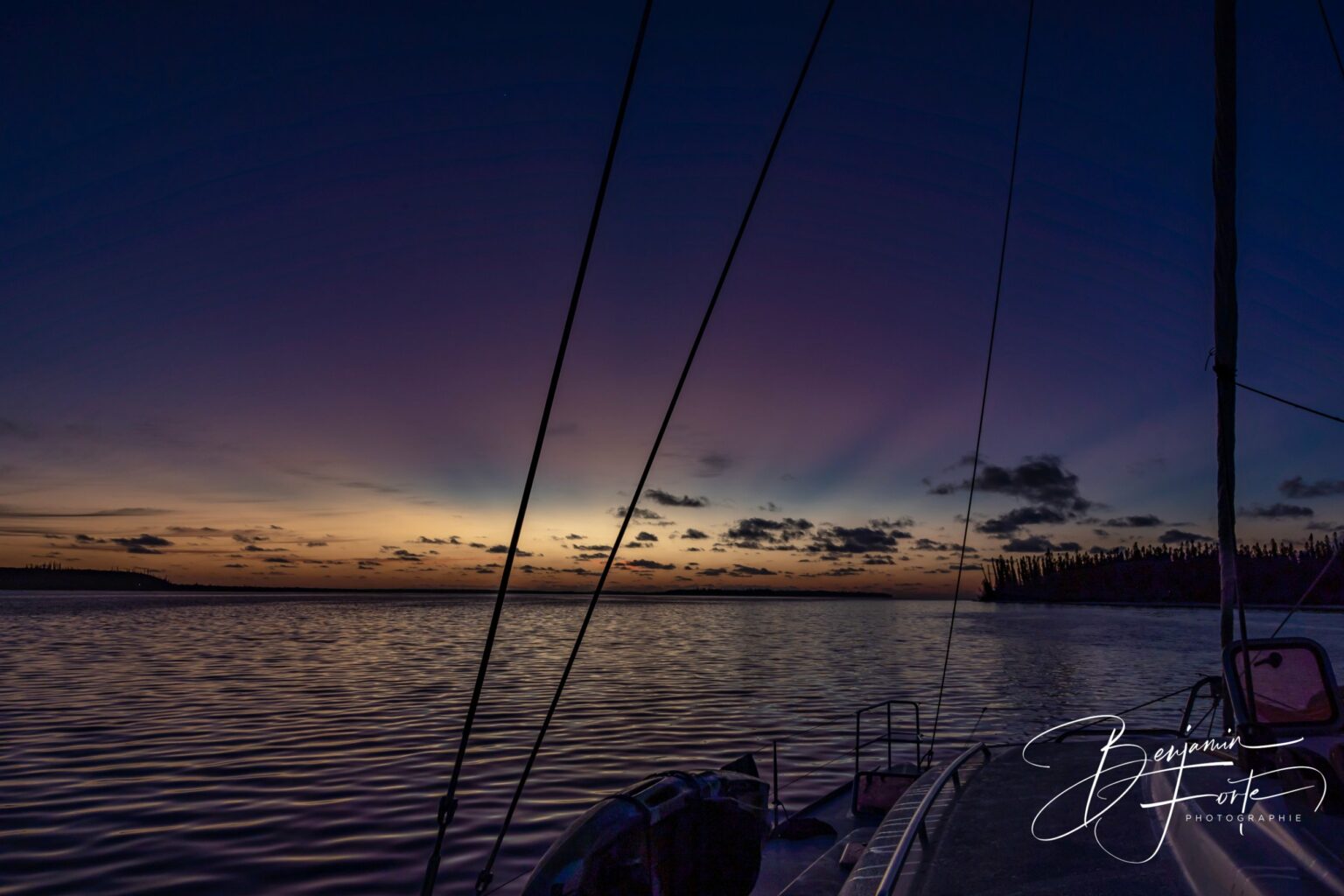
What a catamaran changes at anchor
With a draft of 1.3 m, a Lagoon 440 can get closer to the beach than a monohull of the same size and use shallow sandy patches where the water is often calmer. That is a real advantage, as long as you remember the other dimension: 7.7 m of beam and a lot of windage. The boat pulls hard on her ground tackle as soon as the wind picks up, and she takes up room when she swings.
In practice we anchor in sand, with a bridle to share the load between both bows, plenty of chain and a swinging circle planned for us and for our neighbours. An anchorage that is comfortable in a steady trade wind can turn into a trap if the wind shifts, and that is the question to ask before choosing. We also think about the dinghy ride: a sheltered spot a long way from the beach can be less practical than a slightly more open one close in.
The nearby islets: Maître, Canard and Amédée
Îlot Maître and Îlot Canard are almost within sight of Anse Vata. They are perfect for a calm day or night, but very busy at weekends, between shuttle boats, kitesurfers and powerboats. They are fair-weather anchorages, open as soon as the wind goes into the west.
Amédée, with its lighthouse, is a little further out, near the Boulari pass. Excursion boats arrive during the day, so we prefer to be there early in the morning or late in the afternoon. All three islets are Southern Province sustainable management areas: fishing, collecting anything, drones and camping are banned, which goes a long way to explaining why the reefs look so good.
Prony Bay
In the far south of the main island, Prony Bay offers shelter from almost every wind direction. Baie du Carénage, in the north-west, has two well-protected anchorages in 10 to 15 m of water, which means plenty of chain. Moorings are available around Îlot Casy. Much of the bay is a protected area, and fishing is banned at certain times of year in the Grand Port sector. Depending on the season you may meet humpback whales: keep your distance and slow down.
Isle of Pines: Kuto or Kanumera
The two bays are separated by the Kuto peninsula, and the choice depends on the wind. Kuto is the go-to anchorage in easterlies: large, sandy, with a beach where landing the dinghy is easy. Just keep clear of the wharf and the area marked by yellow buoys, which the ferry uses. Kanumera, on the other side, gives better shelter when the wind goes west; in its western cove watch out for a large coral head lying just below the surface. On the island some bays are closed to boats and customary practice matters, so ask locally and respect the signs.
The southern lagoon
Between Prony and the Isle of Pines, the great southern lagoon is part of New Caledonia’s lagoons listed as a UNESCO World Heritage site. There are plenty of islets and sandy anchorages, but the charts do not tell you everything: isolated coral heads, reef flats that dry, and navigation marks that are sometimes hard to spot. We sail there in daylight, with the sun high or behind us and someone on the bow reading the water. A shallow draft is no excuse for cutting corners, literally or otherwise.
Moorings and protected area rules
The Southern Province maintains a large number of public moorings in its protected areas. Its lagoon guide sets out a few rules that we follow to the letter:
- approach slowly, into the wind or current, watching for swimmers;
- take the moorings closest to shore first to leave room for later arrivals;
- check the condition of the mooring, since you remain responsible for your boat;
- keep at least 5 m between the buoy and the cleat, and lengthen the line if the buoy is pulled under;
- above 20 knots of wind, safety is not guaranteed for boats over 10 m.
At 13.6 m, myCloud falls under that last point: when the forecast goes above it, we leave the mooring for a sheltered anchorage. Everywhere else the anchor goes down on sand, never on coral or seagrass, which an anchor and chain can destroy in minutes. Rubbish goes back aboard, and no fish scraps or food go over the side near the islets or the coast.
Westerly blows
The prevailing wind is the south-east trade, and most anchorages in the southern lagoon suit it. Westerly blows, often linked to a passing front, turn things around: a comfortable islet becomes a lee shore with a short chop that builds fast. We check Météo-France New Caledonia before every night out, and always keep a fallback in mind: an enclosed bay, Prony, or a return to the marina.
In the logbook. For each anchorage: date, forecast and actual wind, type of bottom, length of chain, mooring or anchor, how the night went, and what we would do differently. No precise position: the description is enough to remember it.