

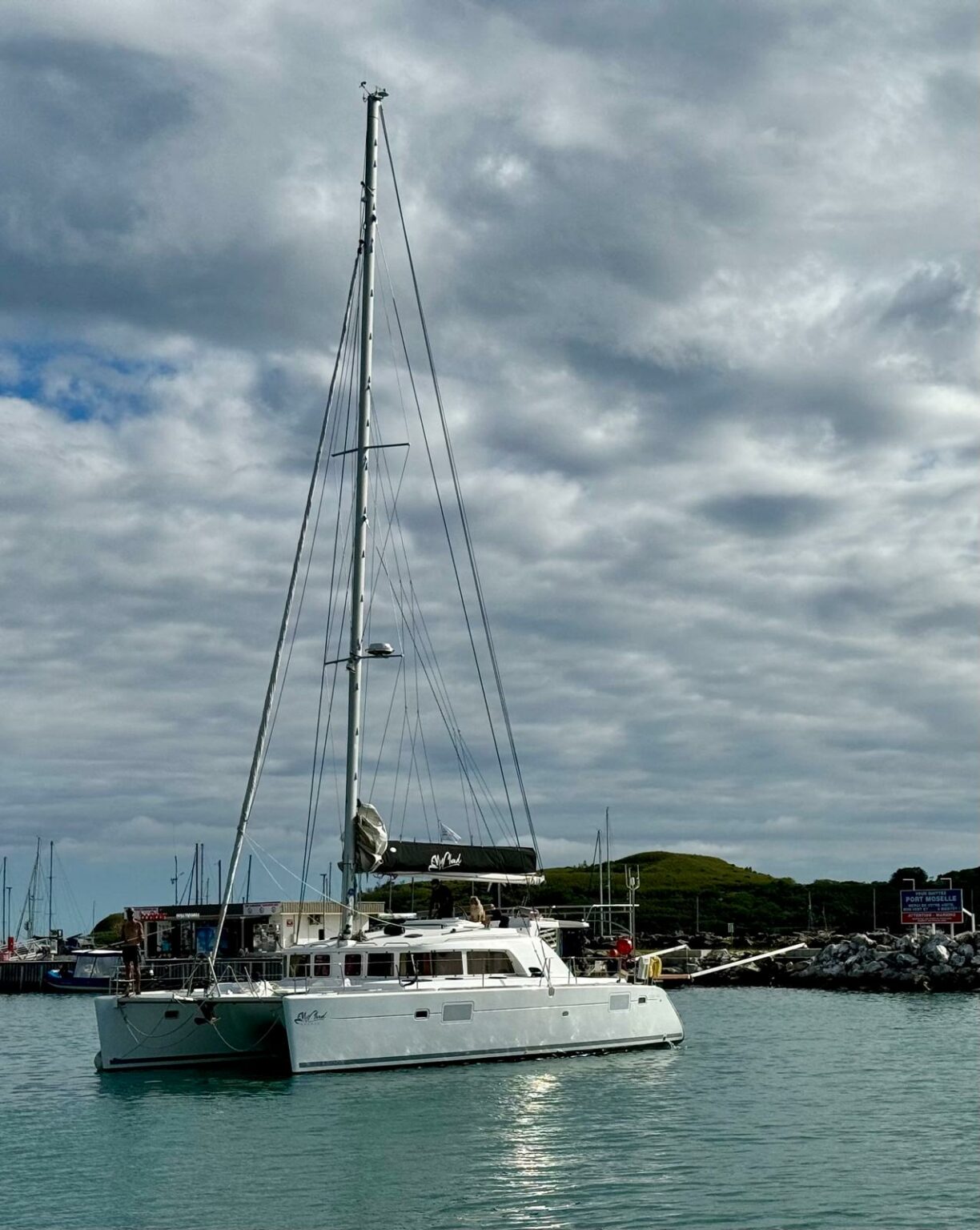
The purchase price of a catamaran is only the entry ticket: what weighs over the years are the recurring costs and the ones nobody puts in the spreadsheet. Here are the items we have learned to budget for on myCloud, our Lagoon 440 based in Noumea, and how we keep track of them.
A rule of thumb, not a law
You often read that you should set aside around 10% of a boat’s value each year for upkeep. It is a common rule of thumb and a useful way to get an order of magnitude, but it hides huge variations. A recent boat that rarely leaves the dock will cost less; a fifteen-year-old boat that sails regularly can cost far more in a given year, and much less the next.
On a catamaran there is one more simple factor: almost everything comes in pairs. Two engines, two saildrives, two hulls to antifoul, twice as many through-hulls and a larger deck area. So rather than one global percentage, we reason item by item, each with its own next due date.
Fixed costs you forget to review
- Insurance. The premium depends on the agreed value, the cruising area and, here, the conditions attached to the cyclone season. Reread the excesses and exclusions every year: that is where the real cost hides on the day of a claim.
- The berth. In Noumea, whether at Port Moselle, Port du Sud or elsewhere, a 7.7 m wide catamaran does not fit where a monohull does. Beam often affects both the price and the availability of berths. Add electricity and water if they are billed separately.
- Haul-outs. Lifting, blocking, antifouling two hulls, anodes, saildrive checks. The real cost includes the extra yard days when something turns up once the boat is out of the water.
Machinery: everything multiplies
myCloud carries two Yanmar 4JH4-AE engines, two SD50 saildrives and a 9.5 kW Cummins Onan generator whose hour meter read around 1,600 hours in 2026. Every oil change, every set of filters, every impeller is counted twice, sometimes three times. Those consumables are predictable. What catches you out are wear parts failing on both sides at once, and jobs postponed until they become urgent, and therefore more expensive. We go into what to do yourself and what to hand over in our article on the engines.
Sails, rigging, electronics: big bills, far apart
These items do not come up every year, and that is exactly the trap. A new set of sails, replacing the standing rigging, an autopilot, a chartplotter or a battery bank all mean large sums at long intervals.
The method that works for us: estimate the remaining life of each item, divide its replacement cost by the number of years left, and put that share aside every year. You do not spend more; you simply avoid discovering the whole bill at once.
Structural surprises: the line no budget sees coming
Our 2024 to 2026 refit proved the point. We had planned for the coachroof windows and deck hatches. We had not planned on a composite yard rebuilding the bows, the transoms and the engine mounts in April 2025, nor on reinforcing the mast bulkhead with unidirectional carbon strips laid in a T and diagonally around the door openings, nor on adding hull-bottom stiffeners. The mast bulkhead job alone took more than half of the structural budget.
Then, in Vanuatu, we found that the forward hull-to-deck joint was held only by the trampoline hinge screw and a bead of silicone, which explained the water getting into the forward ends of the hulls. Patrick, our marine joiner, spent more than a month redoing and re-glassing it all.
The lesson: on a boat of this age, keep a separate contingency reserve that you never dip into for comfort upgrades. And get a survey before buying, knowing that a survey cannot see what lies behind the interior linings.
Budgeting item by item, in practice
- List your items: insurance, berth, haul-out, engines, generator, sails and rigging, electronics, power, safety, tender, structure, contingency.
- For each one, separate the recurring (what comes back every year) from the provisioned (a future replacement divided by the years remaining).
- Give each item a next due date, not just an amount.
- Compare planned and actual twice a year, at the end of the cool season and again before the cyclone season.
Several currencies, one clear picture
In Noumea, the marina and local contractors are paid in Pacific francs (XPF). Parts are ordered in euros from mainland France, in US dollars from some distributors, in Australian dollars when supplies come through Australia. Because the Pacific franc is pegged to the euro, that pair stays stable; for USD and AUD the rate moves from one order to the next. If every expense stays in its own currency without conversion, the yearly total means nothing.
Our rule: record each expense in the currency actually paid, with its date and invoice, then convert it into a reference currency for the totals. It is one of the reasons we built the myCloud boat management app: expenses are entered in XPF, EUR, USD or AUD and linked to a piece of equipment or a zone of the boat. Automatic invoice reading is ready but not yet switched on; for now, entry is manual, which at least forces you to file things properly.
In the logbook. Every expense is linked to a budget item and a piece of equipment. At the end of the year, the total is not what teaches us most; it is the list of items where actual spending went over plan, and why.