

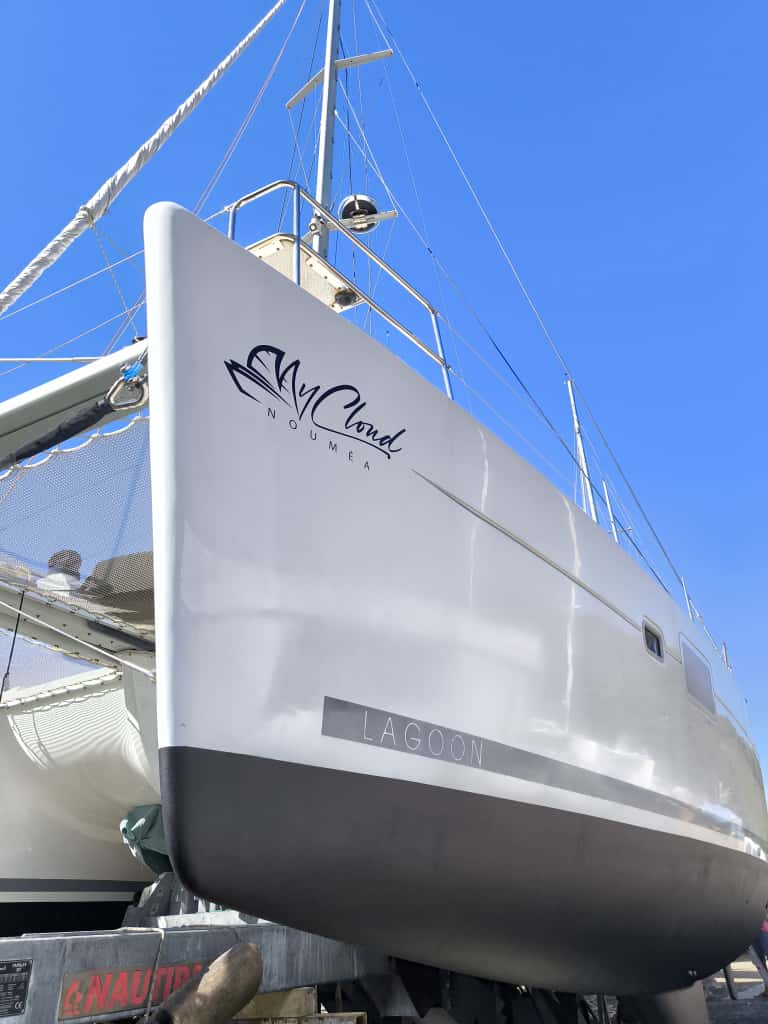
In Noumea, the hard part of antifouling a catamaran is not the paint, it is getting out of the water. At 7.7 m wide, myCloud does not fit everywhere, and a haul-out has to be planned weeks ahead. Here is what we have learned about lifting, timing and doing it cleanly.
The crucial point: beam
A travel lift is a wheeled gantry that straddles the boat. Its capacity in tonnes matters, but for a catamaran the deciding figure is the clear width between its legs. A Lagoon 440 is 7.7 m across. Some of the lifting gear in Noumea has a published maximum beam of around 6 m, plenty for a 15 m monohull and nowhere near enough for us.
So before you even talk dates, ask the yard three things: the usable width between the legs, the real lifting capacity, and how far apart the slings can be set. For weight, do not rely on the light displacement in the brochure: a cruising catamaran with full tanks, a tender on davits and all the gear of life aboard weighs a good deal more. The lifting points are shown in the owner’s manual; have it to hand on the day.
The options in Noumea
Leisure boat repair work is concentrated mainly around Nouville, where the main yards able to haul cruising yachts are found. For a multihull you have to check case by case: depending on the yard, the boat may come out on a travel lift if it is wide enough, on a suitable trailer or cradle up a slipway, or by crane. Each has its own constraints on approach depth, wind and timing.
At Numbo, the New Caledonia government has launched a maritime hub project that includes a careening area, lifting gear suited to the local and regional fleet, and storage space for the cyclone season. It is worth keeping an eye on, but check what is actually in service before you count on it.
The Port Moselle and Port du Sud marina offices know the current options and can point you in the right direction. And hardstand space is scarce: many cruisers say so, and you need to book early, sometimes very early.
When to haul out in New Caledonia
The warm lagoon water is a joy for swimming and a curse for hulls. Growth takes hold quickly, especially in a marina, and tired antifouling shows within a few months. Many owners aim for a yearly haul-out, adjusted to the product, how the boat is used and what you see when you dive on the hull.
As for timing, we prefer the cool season, from May to October. There is less rain, humidity drops and paint cures in better conditions. During the cyclone season, from November to April, showers can stall a job for days, and a boat on stands during a cyclone alert raises other questions to settle with the yard and your insurer. Before a big trip, to Vanuatu for instance, it also makes more sense to haul out a few weeks before leaving than straight after coming home.
Wash water and the environment
New Caledonia’s lagoons are World Heritage listed, and antifouling residue has no place in them. A properly equipped careening area collects the water from pressure washing and treats it before discharge. That is one of the main reasons to use a yard rather than scrub a hull afloat or on a beach.
The exact rules depend on the site and who runs it. Check with the yard, the port operator and the Southern Province before you start, particularly if you are thinking of cleaning the hull in the water between haul-outs: brushing a painted hull releases paint into the water.
Our checklist for a Noumea haul-out
It adds to the general preparation covered in our haul-out article, with the points that are specific to a catamaran here.
- Get the usable width and capacity of the lift confirmed in writing.
- Book the lift and the hardstand space together, with a relaunch date.
- Check the depth on the approach to the yard at your planned time: 1.3 m is not much, but the tide still matters.
- Plan the approach for light wind: 7.7 m of beam and a lot of windage are tricky in a narrow basin.
- Use the haul-out for both SD50 saildrives: seals, anodes, propellers.
- Inspect through-hulls, transducers and rudders while everything is accessible.
- Sort out water and power on the hardstand, and whether you will live aboard or not.
- Photograph the hull as soon as it is out, before any washing, and again before relaunching.
In the logbook. Haul-out date, lifting method, photos of the hull before washing, antifouling product and number of coats, anodes replaced, saildrive seal condition, relaunch date. Next haul-out date set straight away.